
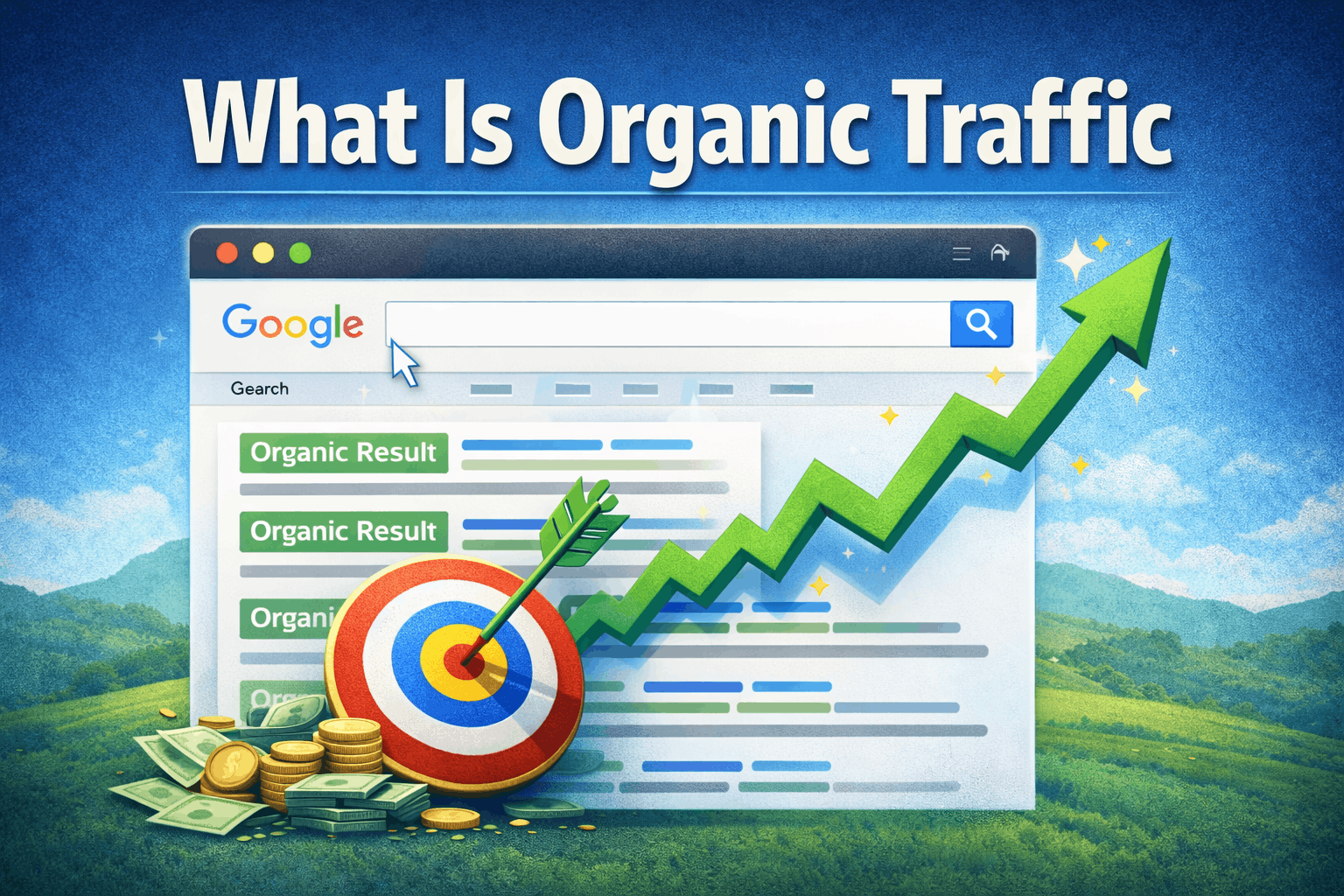
You know that feeling when someone finds your website on Google without you paying a single rupee for ads? That’s organic traffic, and it’s pure gold. Let me show you exactly how it works and how you can get more of it.
What Is Organic Traffic? (Let’s Keep It Simple)
Imagine you’re searching for “best filter coffee in Bangalore” on Google. You scroll past those “Ad” labels at the top and click on the third result because it looks trustworthy. Congratulations—you just became organic traffic for that website!
Organic traffic = People who find your website through unpaid search results.
No ads. No paid promotions. Just your website showing up naturally when someone searches for something you offer.
Here’s why it matters: When someone clicks on your site from Google’s organic results, they’re actively looking for what you have. They’re not being interrupted by an ad—they’re on a mission, and you’re the answer.
Why Organic Traffic Is Better Than Paid Traffic
Let me be honest with you. Paid ads stop working the moment you stop paying. Organic traffic? It keeps flowing even while you sleep.
Think about it:
- Paid traffic costs money every single time someone clicks
- Organic traffic is free once you rank
- People trust organic results more than ads (studies show 70% of clicks go to organic results)
- Organic traffic builds long-term value for your business
As an SEO freelancer in Bangalore, I’ve seen businesses transform when they shift focus from paying for every click to earning organic visibility. One local bakery I worked with was spending ₹30,000 monthly on Google Ads. After six months of SEO work, they cut their ad spend by 60% because organic traffic was bringing in enough customers.
How Does Organic Traffic Actually Work?
Picture Google as the world’s smartest librarian. When someone asks a question, Google searches through billions of web pages to find the best answers.
Here’s the simple process:
Step 1: You create content on your website (like this article you’re reading right now)
Step 2: Google’s robots (called Googlebot) discover and read your content
Step 3: Google analyzes whether your content is helpful, trustworthy, and relevant
Step 4: Google ranks your page based on quality, keywords, and hundreds of other factors
Step 5: When someone searches for related topics, your page shows up in the results
Step 6: People click on your result and visit your website—that’s organic traffic!
The beauty of this system? Once you’re ranking well, you can get thousands of visitors without spending money on each click.
Types of Organic Traffic (Yes, There Are Different Kinds!)
Not all organic traffic is created equal. Let me break down the main types:
1. Search Engine Traffic (The Big Kahuna)
This is traffic from Google, Bing, or other search engines. Someone types a question or keyword, and boom—your website appears. This is what most people mean when they say “organic traffic.”
Example: Someone in Koramangala searches “SEO freelancer in Bangalore,” finds your website, and clicks. That’s search engine organic traffic.
2. Direct Traffic
When someone types your website URL directly into their browser or has it bookmarked. While not technically from search engines, it’s still “organic” because you didn’t pay for it.
3. Social Media Traffic (When Done Right)
If someone finds your blog post shared on LinkedIn or Twitter and clicks through—that’s organic social traffic. You didn’t pay for that social media ad; they found it naturally.
4. Referral Traffic
When another website links to yours and people click that link. It’s organic because you earned that link through quality content, not by paying for it.
Why Should You Care About Organic Traffic?
Let me paint you a picture. There are two ways to fill a bucket with water:
Option 1: Stand there with a cup, pouring water in manually every single day (that’s paid advertising)
Option 2: Set up a rainwater collection system that fills your bucket automatically (that’s organic traffic)
Which sounds better?
The Real Benefits Nobody Tells You About
It’s sustainable. Once you rank for a keyword, you can stay there for months or even years with minimal maintenance. I have clients ranking for competitive terms since 2023, still getting traffic without additional investment.
It builds trust. When people see you ranking organically, they think “This business must be legit if Google shows them first.” You can’t buy that kind of credibility with ads.
It compounds over time. Every piece of content you create can bring traffic for years. Write one great article today, and it could bring you customers in 2027, 2028, and beyond.
It’s cost-effective. Sure, SEO requires effort upfront (or hiring an SEO freelancer in Bangalore like me), but the long-term ROI crushes paid advertising. One well-optimized page can bring you ₹10 lakhs worth of business over its lifetime without ongoing ad spend.
It targets people at the right moment. Someone searching “best CRM software for small business” is ready to buy. Someone seeing a random ad for CRM software? Maybe not so much.
How to Increase Your Organic Traffic (The Strategies That Actually Work)
Alright, enough theory. Let’s get into the practical stuff that’ll actually move the needle for your website.
1. Start With Keyword Research (Find What People Are Searching For)
You can’t rank for keywords you don’t target. Keyword research is finding out what your potential customers are typing into Google.
Here’s how to do it simply:
Use free tools like Google’s Keyword Planner, Ubersuggest, or even just Google’s search bar. Type in your main topic and see what suggestions pop up—those are real searches people are making.
Example: If you’re a yoga studio in Bangalore, don’t just target “yoga classes.” Look for specific searches like:
- “yoga for beginners in Indiranagar”
- “morning yoga classes near me”
- “prenatal yoga Bangalore”
- “best yoga studio HSR Layout”
These longer, specific phrases (called long-tail keywords) are easier to rank for and bring people who know exactly what they want.
Pro tip from an SEO freelancer in Bangalore: Focus on keywords where you can genuinely provide value. Don’t chase high-volume keywords if you can’t create better content than what’s already ranking.
2. Create Content That People Actually Want to Read
This is where most people mess up. They create content for search engines instead of humans.
Google is smart now. Really smart. It knows if your content is helpful or just keyword-stuffed nonsense.
What makes great content?
Answer the actual question. If someone searches “how to fix a leaky faucet,” don’t spend 800 words talking about the history of plumbing. Get to the solution fast.
Make it readable. Short paragraphs. Simple words. Conversational tone. (Notice how I’m writing this? That’s intentional.)
Go deeper than your competitors. If the top-ranking article has 10 tips, give 15. If they have basic explanations, add examples, screenshots, or personal stories.
Update regularly. That blog post from 2019? Update it with 2026 information. Google loves fresh content.
I worked with a fitness coach who had a blog post about “home workouts.” It was getting maybe 20 visitors a month. We updated it with new exercises, added videos, and made it more comprehensive. Six months later? 500+ visitors monthly, all organic.
3. Optimize Your Pages for Search Engines (Without Being Annoying)
SEO optimization doesn’t mean stuffing keywords into every sentence. It means making it easy for Google to understand what your page is about.
The essentials:
Use your main keyword in the title. If you’re targeting “organic traffic,” make sure it’s in your headline (like I did with this article).
Write compelling meta descriptions. That little preview text under your title in Google results? Write it like an ad that makes people want to click.
Use header tags properly. H1 for your main title, H2 for main sections, H3 for subsections. This helps Google understand your content structure.
Optimize your images. Use descriptive file names (not “IMG_1234.jpg”) and add alt text that describes the image. This helps Google “see” your images.
Make your URLs simple. “yoursite.com/what-is-organic-traffic” is better than “yoursite.com/p?id=12345&cat=blog.”
Add internal links. Link to your other relevant pages. It helps Google discover your content and keeps visitors on your site longer.
4. Build High-Quality Backlinks (Get Other Websites to Vouch for You)
Think of backlinks as votes of confidence. When a reputable website links to yours, Google sees it as “Hey, this content must be valuable.”
But here’s the thing: not all backlinks are created equal. One link from The Hindu or Economic Times is worth more than 100 links from random spam sites.
How to get quality backlinks naturally:
Create link-worthy content. Write the definitive guide on your topic. Create original research. Make something so valuable that others naturally want to reference it.
Guest post on relevant blogs. Reach out to websites in your industry and offer to write a quality article for them (with a link back to your site).
Get listed in directories. Local business directories, industry-specific listings, and resource pages can provide solid backlinks.
Build relationships. Connect with other business owners, bloggers, and influencers in Bangalore. Real relationships lead to natural backlinks.
Create shareable resources. Infographics, templates, tools, or research that others want to share and link to.
As an SEO freelancer in Bangalore, I’ve seen clients waste money on cheap backlink packages that actually hurt their rankings. Focus on quality, not quantity.
5. Improve Your Website Speed and User Experience
Imagine walking into a store where everything takes forever to load, the aisles are confusing, and half the products are impossible to find. You’d leave, right?
That’s what happens when your website is slow or hard to navigate. And Google knows it.
Quick wins for better site speed:
Compress your images. Large image files are the number one reason websites load slowly. Use tools like TinyPNG to compress without losing quality.
Use a good hosting provider. Cheap hosting saves you ₹500 monthly but costs you thousands in lost traffic. Invest in reliable hosting.
Enable browser caching. This lets returning visitors load your site faster because some elements are saved on their device.
Minimize plugins. If you’re on WordPress, every plugin you add can slow things down. Only use what you absolutely need.
Make it mobile-friendly. More than 60% of searches happen on mobile devices. If your site doesn’t work well on phones, you’re losing more than half your potential traffic.
Google actually considers site speed as a ranking factor now. A one-second delay in loading time can reduce conversions by 7%.
6. Focus on Local SEO (Especially If You’re in Bangalore)
If you’re serving local customers, local SEO is your secret weapon. When someone searches “SEO freelancer in Bangalore” or “restaurants near me,” Google shows local results first.
How to dominate local search:
Claim your Google Business Profile. This is free and crucial. Fill out every section completely—hours, photos, services, description, everything.
Get reviews. Ask happy customers to leave Google reviews. More reviews + higher ratings = better local rankings.
Use local keywords. Include your city, neighborhood, or landmark in your content naturally. “Best pizza in Koramangala” instead of just “best pizza.”
Create location-specific pages. If you serve multiple areas, create dedicated pages for each location.
List your business in local directories. JustDial, Sulekha, and other local listings help your visibility.
I’ve helped dozens of Bangalore-based businesses increase their local organic traffic by 200-300% just by optimizing their Google Business Profile and creating location-specific content.
7. Analyze and Adjust (Because What Gets Measured Gets Improved)
You can’t improve what you don’t measure. Set up Google Analytics and Google Search Console (both free) to track your organic traffic.
What to monitor:
Which pages get the most organic traffic? Double down on what’s working.
Which keywords are you ranking for? You might be ranking for terms you didn’t even target—create more content around those topics.
What’s your bounce rate? If people are leaving immediately, your content isn’t matching what they expected. Fix it.
How long are people staying on your site? Longer time on page tells Google your content is valuable.
Which pages have the highest conversion rates? Traffic is great, but traffic that converts into customers or leads is the goal.
Check your analytics monthly. Look for patterns. Double down on what works and fix what doesn’t.
Common Organic Traffic Mistakes (And How to Avoid Them)
Let me save you from the mistakes I see all the time:
Mistake 1: Targeting keywords that are too competitive. If you’re a new website, you’re not going to rank for “digital marketing” anytime soon. Target specific, long-tail keywords instead.
Mistake 2: Creating thin content. A 300-word blog post won’t cut it anymore. Google wants comprehensive, valuable content (like this 2,500+ word guide).
Mistake 3: Ignoring search intent. If someone searches “best running shoes,” they want product recommendations, not a history of running shoes. Match your content to what searchers actually want.
Mistake 4: Not optimizing for mobile. I can’t stress this enough—mobile-first is not optional anymore.
Mistake 5: Expecting instant results. SEO is a long game. Most websites see significant organic traffic growth after 4-6 months of consistent effort. Be patient.
Mistake 6: Keyword stuffing. Writing “SEO freelancer in Bangalore” 50 times in your article won’t help. Google’s smarter than that and will actually penalize you.
Mistake 7: Buying backlinks. Those “get 1000 backlinks for ₹5000” offers? They’ll hurt your rankings, not help them.
How Long Does It Take to See Results?
I’ll be straight with you: organic traffic growth takes time. It’s not like paid ads where you can get traffic tomorrow.
Realistic timeline:
Weeks 1-4: Google discovers and indexes your content. You might see a little traffic, but nothing major.
Months 2-3: Your rankings start improving for less competitive keywords. Traffic begins to grow slowly.
Months 4-6: This is where you usually see significant growth if you’ve done things right. Rankings improve, traffic increases noticeably.
Month 6+: Compounding effects kick in. Your site has authority, your content is ranking for multiple keywords, and traffic grows consistently.
I’ve worked with clients as an SEO freelancer in Bangalore who saw results in 8 weeks and others who took 6 months. It depends on your industry competition, current website authority, and how aggressively you’re creating content.
The key? Stay consistent. Don’t give up after two months because you’re not seeing explosive growth yet.
Real-World Example: How I Increased Organic Traffic for a Bangalore Client
Let me share a quick case study. I worked with a local interior design studio in Bangalore that was getting maybe 200 website visits per month, mostly from paid ads.
Here’s what we did:
Created a comprehensive blog covering topics like “small apartment design ideas Bangalore,” “vastu-compliant home design,” and “best interior designers in Bangalore.”
Optimized their Google Business Profile with photos of their projects, got 25+ five-star reviews from happy clients.
Built high-quality backlinks by reaching out to local home décor blogs and offering to contribute expert advice.
Made their website mobile-friendly and improved loading speed from 8 seconds to under 3 seconds.
Created location-specific pages for each area they served—Koramangala, Indiranagar, Whitefield, etc.
The results after 6 months:
Organic traffic increased from 200 to 2,800 monthly visitors. They were ranking on page one for 15+ keywords. Most importantly, they were getting 10-15 qualified leads per month from organic search alone.
Their ad spend? Cut by 70% because organic traffic was bringing in enough business.
Your Action Plan: Start Increasing Organic Traffic Today
Feeling overwhelmed? Don’t be. You don’t have to do everything at once. Here’s your simple roadmap:
This week:
- Set up Google Analytics and Google Search Console if you haven’t already
- Do keyword research for your top 5 topics
- Write one comprehensive, helpful blog post targeting one keyword
This month:
- Create and optimize your Google Business Profile (if you’re a local business)
- Audit your website speed and fix major issues
- Write 4-6 quality blog posts or update existing ones
Next 3 months:
- Publish 2-3 quality articles per week
- Reach out to 5-10 websites for guest posting or collaboration opportunities
- Monitor your analytics and adjust based on what’s working
Long-term:
- Keep creating valuable content consistently
- Build relationships in your industry for natural backlinks
- Update and improve your existing content regularly
Remember: SEO is a marathon, not a sprint. The websites ranking at the top of Google today didn’t get there overnight—they got there by consistently creating value.
Final Thoughts: Organic Traffic Is Worth the Effort
Look, I get it. Organic traffic growth sounds like a lot of work compared to just throwing money at Google Ads. And honestly? It is more work upfront.
But here’s what I’ve learned after years as an SEO freelancer in Bangalore: businesses that invest in organic traffic build real, sustainable growth. They’re not at the mercy of rising ad costs. They’re not panicking every time their ad budget runs out.
They’ve built something that keeps working for them, month after month, year after year.
Whether you decide to do this yourself or hire someone like me to help, the important thing is to start. Every day you wait is a day your competitors are building their organic traffic while you’re paying for every click.
Your future self will thank you for starting today.
Need help growing your organic traffic? As an SEO freelancer in Bangalore, I help businesses like yours rank higher on Google and get more qualified visitors without paying for ads. Let’s chat about your goals and create a custom strategy that works for your business.
Remember: The best time to start building organic traffic was six months ago. The second best time is today.

I am Abhijeet Banerjee a dedicated SEO Specialist focused on driving organic growth and improving search visibility. I use a data-driven approach to technical SEO, content strategy, and link building to deliver measurable results and increase ROI for clients and projects