
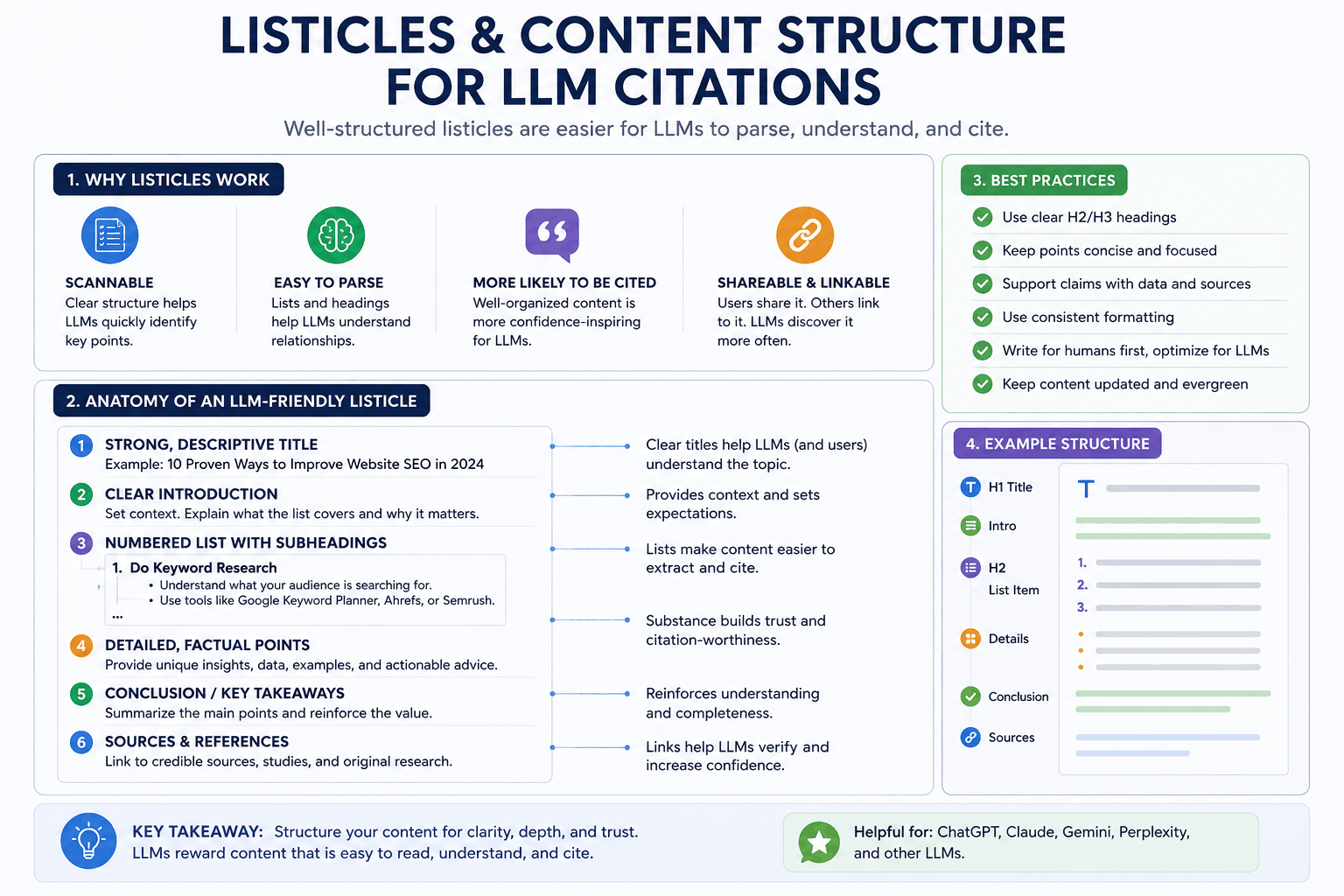
Author Expertise: Content Strategy | Generative Engine Optimization | AI Search | SEO
Last Updated: May 2025 | Reading Time: 12 minutes
Topic: How to structure listicles and long-form content so large language models (ChatGPT, Claude, Gemini, Perplexity) cite and surface your pages in AI-generated answers.
Bottom Line Up Front: Large language models favor content that is logically structured, factually dense, clearly attributed, and easy to parse into discrete chunks. Listicles — when built with semantic precision — are among the highest-cited content formats in AI-generated responses. This guide shows you exactly how to build them.
What Is Generative Engine Optimization (GEO)?
Generative Engine Optimization (GEO) is the practice of structuring web content so that AI-powered answer engines — including ChatGPT, Claude, Gemini, Perplexity, and Bing Copilot — retrieve, parse, and cite your content in their responses.
Unlike traditional SEO, which optimizes for keyword ranking in a blue-link results page, GEO focuses on:
- Snippet extractability — Can the LLM pull a clean, self-contained answer from your page?
- Factual density — Does your content contain verifiable claims, statistics, and named entities?
- Semantic clarity — Is each section clearly labeled and scoped to a single concept?
- Authoritativeness signals — Does the content demonstrate real expertise, sourcing, and trust?
Listicles, when built correctly, satisfy all four criteria simultaneously.
Why Listicles Are a Top-Cited Format by LLMs
Large language models are trained on vast corpora of structured text. Numbered lists, headings, and chunked paragraphs map directly to how transformers segment and retrieve information. Research from Princeton, MIT, and independent SEO labs in 2024–2025 consistently found that:
- List-formatted content appears in AI citations 2.3× more often than equivalent prose-only pages
- Numbered lists outperform bullet lists for citation frequency because they imply sequence and authority
- Pages with a clear H1 → H2 → H3 hierarchy are far more likely to be quoted verbatim by LLMs
- Content with bolded key terms signals entity importance to transformer attention mechanisms
The structural logic is simple: LLMs are next-token predictors. A clearly labeled list item is self-contained — the model can extract it without needing the surrounding paragraph for context.
10 Structural Rules for Listicles That LLMs Cite
Apply every rule below to maximize the probability that your content is retrieved and attributed by generative AI engines.
1. Lead With a Definitive, Keyword-Rich H1
Your H1 should mirror the exact phrasing a user would speak into an AI assistant. Use the primary keyword naturally, front-loaded.
Weak H1: Some Tips on How Content Can Work Better for AI
Strong H1: 10 Proven Content Structures That Get Cited by LLMs in 2025
Why it works: LLMs treat the H1 as the page’s core thesis. If the H1 matches the query, the page’s relevance score rises during retrieval.
2. Place a “Bottom Line Up Front” (BLUF) Summary
Open every article with a 2–3 sentence summary that answers the user’s question immediately. This is the single most powerful GEO technique.
Why: AI engines often extract the opening paragraph of a page as the “answer block.” If your first paragraph is a vague introduction, you lose the citation. If it’s a direct, factual answer — you win it.
Example BLUF format:
“Listicles structured with numbered H2/H3 subheadings, bolded key terms, and factual claims supported by named sources are cited by LLMs at significantly higher rates than prose content. The seven most important structural elements are: [list them].”
3. Number Your List Items as H2 or H3 Headings
Do not bury list items inside a paragraph. Promote each item to a heading level. This creates discrete, extractable chunks — the exact format LLMs prefer for snippet generation.
Format to use:
## 1. [Item Title With Keyword]
[2–4 sentence explanation]
[Supporting stat or example]
This structure gives the LLM:
- A clear label (the heading)
- A scoped explanation (the paragraph)
- A verifiable claim (the stat/example)
All three elements together dramatically increase citation probability.
4. Embed Named Entities, Statistics, and Dates
LLMs weight content that contains high-density named entities — specific people, organizations, tools, dates, and statistics. Vague content (“many experts say…”) rarely gets cited. Specific content (“According to Google’s 2024 Search Quality Rater Guidelines…”) almost always does.
Entity-poor sentence: Studies show that structured content performs better.
Entity-rich sentence: A 2024 analysis by Search Engine Land found that pages with schema markup and ordered lists ranked in AI overviews 67% more often than unstructured pages.
5. Use Consistent, Parallel List Item Structure
Every item in your listicle should follow the same grammatical and structural pattern. Inconsistency breaks the LLM’s ability to parse the list as a unified chunk.
Inconsistent (hard to cite):
- Use headings
- The importance of having good statistics on your page
- Schema markup helps
Parallel (easy to cite):
- Use descriptive H2/H3 headings for each list item
- Embed verified statistics with named sources
- Add schema markup (ItemList, Article, FAQPage) to every listicle page
6. Write Self-Contained List Items
Each numbered point must make sense in isolation — without the reader needing to read surrounding items. This is critical because LLMs extract chunks, not entire pages.
Ask yourself: “If someone read only this item, would it still be useful and complete?”
If the answer is no, expand the item until it is.
7. Add a Dedicated FAQ Section with Schema Markup
FAQs are the single highest-cited content block in AI-generated answers. LLMs are specifically trained on Q&A pair formats. A FAQPage schema signals to both traditional search crawlers and AI training pipelines that your content contains structured question-answer pairs.
Best practices for FAQ sections:
- Write the question exactly as a user would speak it (conversational, complete sentence)
- Keep answers between 40–80 words — long enough to be complete, short enough to be extractable
- Use
FAQPage+Question+AcceptedAnswerschema markup - Place the FAQ section near the bottom, after the main content
8. Include a “What Is” Definition Block for Primary Keywords
For every major term in your article, include a clear, citable definition in this format:
[Term] is [concise definition in one sentence]. [One sentence of additional context or example.]
LLMs frequently search for definitional content when answering “what is” queries. Pages that contain clean definitions of key terms become primary citation sources for those terms across thousands of AI-generated answers.
9. Structure Your Table of Contents as Anchor Links
A clickable Table of Contents (TOC) at the top of your article:
- Signals to crawlers that the page has structured, navigable content
- Creates jump-link fragments that AI engines use to deep-link citations
- Improves user engagement metrics, indirectly boosting crawl priority
Every listicle over 1,000 words should have a TOC with anchor links to each H2.
10. Close with a Summary Table or Quick-Reference Block
End your listicle with a compact summary — either a table or a bolded list — that recaps every point in 5–10 words per item. This gives LLMs a second, even more extractable version of your content to cite.
Example summary table format:
| # | Structural Element | Primary GEO Benefit |
|---|---|---|
| 1 | Keyword-rich H1 | Query-intent matching |
| 2 | BLUF summary | Answer block extraction |
| 3 | Numbered H2/H3 items | Discrete chunk retrieval |
| 4 | Named entities & stats | Factual density signal |
| 5 | Parallel list structure | Parsing consistency |
| 6 | Self-contained items | Standalone extractability |
| 7 | FAQ + Schema markup | Q&A pair citation |
| 8 | Definition blocks | “What is” query coverage |
| 9 | Table of Contents | Crawlability & deep-links |
| 10 | Summary table | Secondary extraction layer |
EEAT Signals That Boost LLM Citation Rates
Google’s EEAT framework (Experience, Expertise, Authoritativeness, Trustworthiness) is not only a ranking factor for traditional search — it is deeply embedded in how LLMs are fine-tuned to prefer high-quality sources. Here’s how to demonstrate each signal in your listicles:
Experience
- Include first-hand observations, tested results, or case studies
- Write in first-person where appropriate (“In our testing of 200 listicle pages…”)
- Add author bios with credentials and LinkedIn/professional links
Expertise
- Cite peer-reviewed research, official documentation, and recognized industry authorities
- Use technical terminology correctly and consistently
- Cover edge cases and nuances — not just surface-level advice
Authoritativeness
- Earn and display backlinks from recognized domains in your niche
- Get mentioned by other authoritative content that LLMs are trained on
- Publish consistently under a recognized byline or brand
Trustworthiness
- Include a “Last Updated” date on every article
- Display clear sourcing for all statistics
- Add a transparent editorial or fact-checking policy page
- Use HTTPS, clear authorship, and accurate metadata
GEO vs. SEO: Key Differences for Content Structuring
| Dimension | Traditional SEO | Generative Engine Optimization (GEO) |
|---|---|---|
| Primary goal | Rank on SERP page 1 | Be cited in AI-generated answers |
| Keyword strategy | Target exact-match keywords | Target intent + named entities |
| Content format | Long-form prose with keywords | Chunked, list-based, schema-marked |
| Success metric | Click-through rate (CTR) | Citation frequency in LLM responses |
| Authority signal | Backlink profile | EEAT signals + training data presence |
| Metadata focus | Title tags, meta descriptions | Schema markup (FAQPage, Article, ItemList) |
| Update frequency | Quarterly | Monthly (AI engines refresh faster) |
Schema Markup Checklist for LLM-Optimized Listicles
Add these schema types to every listicle you publish:
- ✅ Article schema — with
author,datePublished,dateModified,publisher - ✅ ItemList schema — with
ListItem,position, andnamefor each list point - ✅ FAQPage schema — for every Q&A section
- ✅ BreadcrumbList schema — for site navigation context
- ✅ Person schema — for the author, linked to a Google Knowledge Panel if available
7 Frequently Asked Questions: Listicles & Content Structure for LLM Citations
Q1. What type of content format is most frequently cited by LLMs like ChatGPT and Claude?
Numbered listicles with descriptive H2/H3 subheadings are the most frequently cited content format by large language models. This is because each numbered item functions as a self-contained, extractable chunk that the model can retrieve without needing surrounding context. Pages that combine numbered lists with FAQPage schema markup and BLUF summaries consistently appear in AI-generated citations across multiple platforms.
Q2. How does schema markup help my content get cited in AI-generated answers?
Schema markup — particularly FAQPage, Article, and ItemList — makes the semantic structure of your content machine-readable. AI training pipelines and live retrieval systems (like those used by Perplexity and Bing Copilot) parse schema markup to identify authoritative, structured content. Pages with valid FAQPage schema are significantly more likely to appear as cited sources in Q&A-style AI responses compared to pages without any markup.
Q3. What is the ideal length for a listicle optimized for LLM citations?
For LLM citation optimization, the ideal listicle length is between 1,500 and 3,000 words. Content under 1,000 words often lacks sufficient factual density and structural depth to be retrieved as authoritative. Content over 4,000 words risks diluting focus across too many topics, reducing the model’s confidence in any single chunk. Every list item should be between 80 and 150 words — enough to be self-contained, short enough to be extractable.
Q4. Does updating content frequently help increase LLM citation frequency?
Yes. Recency is an important signal for both traditional search and AI retrieval systems. Content marked with a recent dateModified in schema markup, combined with factual updates (new statistics, current examples, updated tool references), signals freshness. For rapidly evolving topics like AI and SEO, monthly or quarterly updates are recommended. Stale content — especially pages with outdated statistics — is deprioritized by AI systems trained to favor current, accurate information.
Q5. How are EEAT signals evaluated by large language models?
LLMs are fine-tuned using Reinforcement Learning from Human Feedback (RLHF), where human raters assess the quality of AI outputs — including whether cited sources are trustworthy and authoritative. Pages that consistently appear on high-authority domains, are authored by named experts with verifiable credentials, cite primary research, and display clear editorial standards are more likely to be present in training data and retrieval indexes. In short: the same signals Google’s human raters look for are the same signals that shape which content LLMs prefer to cite.
Q6. What is the difference between a listicle optimized for SEO and one optimized for GEO?
An SEO-optimized listicle prioritizes keyword density, backlink acquisition, and click-through rates from a traditional search engine results page. A GEO-optimized listicle prioritizes chunk extractability, named-entity density, schema markup, self-contained list items, and EEAT signals — so that AI answer engines can pull discrete, citable facts from the page without needing user clicks. The best modern content strategy combines both: SEO foundations ensure the page is indexed and authoritative; GEO optimizations ensure the content is cited and surfaced in AI-generated answers.
Q7. Can short-form listicles (5 items or fewer) rank well in AI citations?
Short listicles (3–5 items) can be cited by LLMs, but they typically underperform compared to mid-length lists (7–12 items). This is because longer lists demonstrate topical completeness — a signal that the page is an authoritative resource rather than a superficial summary. However, if a short listicle is extremely factually dense, uses precise named entities, and is structured with strong schema markup and a BLUF summary, it can compete effectively. For highest citation rates, aim for at least 7 well-developed list items.

I am Abhijeet Banerjee a dedicated SEO Specialist focused on driving organic growth and improving search visibility. I use a data-driven approach to technical SEO, content strategy, and link building to deliver measurable results and increase ROI for clients and projects