
Category: Generative Engine Optimization · SEO Strategy Updated: May 2026 · 14 min read · GEO + EEAT + AIO
Introduction
We are witnessing the most significant reshaping of search in two decades. Google’s AI Overviews now appear on over 30% of all search result pages. Featured snippets, position-zero tactics, and traditional blue-link strategies are no longer sufficient. In 2026, the game is Generative Engine Optimization (GEO) — building content that AI systems trust, cite, and synthesize.
The brands winning in this new landscape are not necessarily the ones with the most backlinks or the highest domain authority. They are the ones whose content is structured to be understood, extracted, and amplified by AI. This guide shows you exactly how to become one of them.
01. What Are AI Overviews — and Why They Change Everything
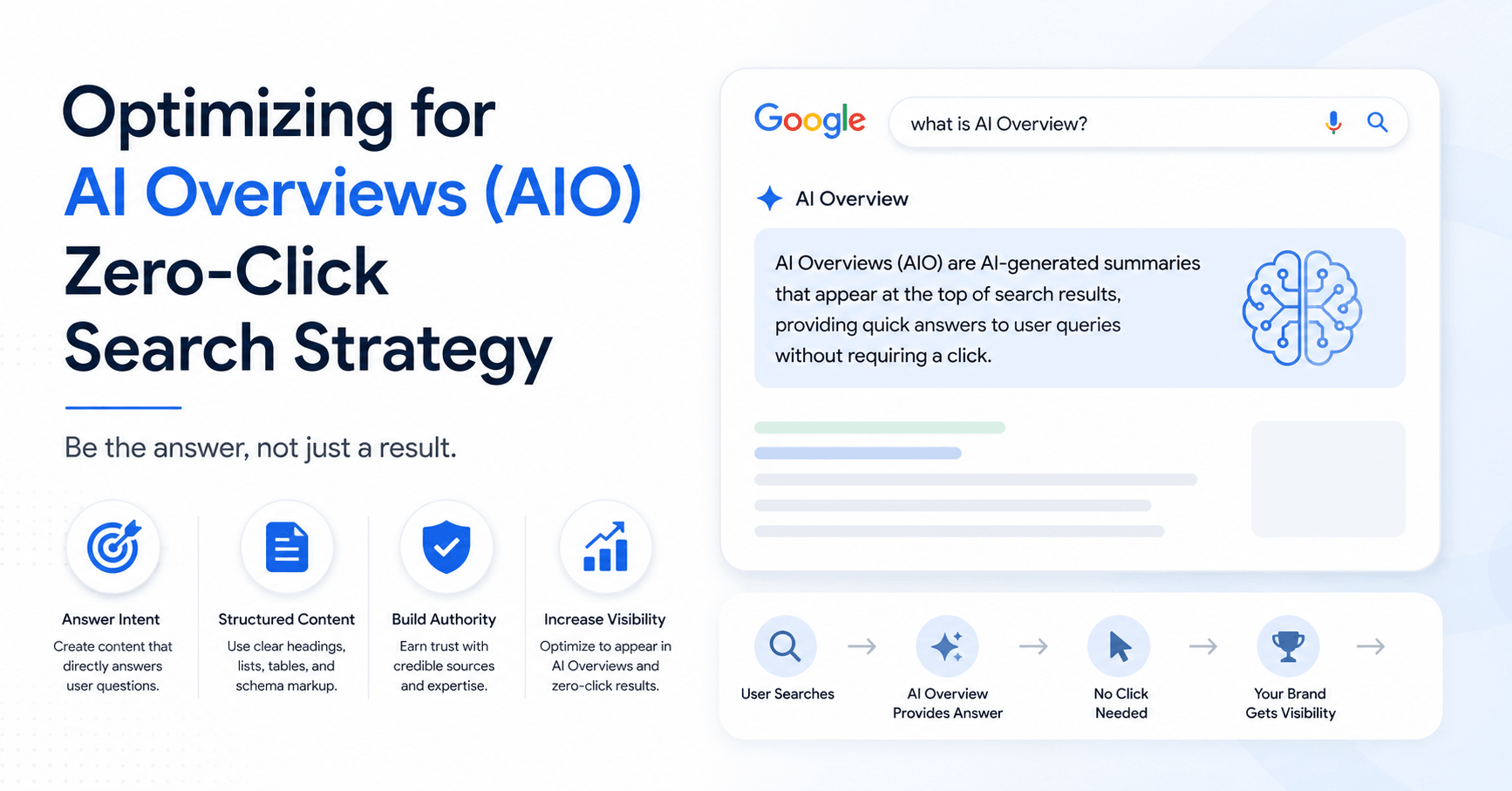
Google’s AI Overviews (AIO), previously piloted as the Search Generative Experience (SGE), are large-language-model-generated summaries that appear above traditional organic results. They synthesize information from multiple web sources, cite those sources with inline links, and answer complex, multi-intent queries in a single unified block.
Unlike featured snippets, which pull a single passage from one page, AI Overviews actively blend content from 3 to 8 sources, weigh source authority, cross-reference factual claims, and present a synthesized answer. Being cited in an AIO is the new “position zero” — but earning that citation requires an entirely different optimization playbook.
How Google Selects AIO Sources
Google’s AIO model evaluates content through a multi-layer ranking process. It first retrieves a large candidate pool via standard search signals, then re-ranks specifically for factual accuracy, source consensus, recency, and EEAT strength. The AI synthesizes across sources it deems complementary, preferring content that fills distinct informational gaps rather than repeating the same information. Content that is comprehensive, accurate, and clearly authored by a credible expert is prioritized over content that is merely keyword-optimized.
This means your new optimization target is not the algorithm crawling your page — it is the language model reading, evaluating, and deciding whether your content deserves to be part of the answer it serves to millions of users.
02. The Zero-Click Reality in 2026
Zero-click searches — where users get their answer directly on the SERP without visiting any website — have crossed the 58.5% threshold in 2026. For purely informational queries, that number approaches 75%. This is not a temporary anomaly; it is the new structural reality of search.
The traditional SEO model — rank, get clicks, convert — is under existential pressure. However, zero-click does not mean zero-value. Brands that appear in AI Overviews gain enormous passive authority: their name, expertise framing, and key claims reach millions of users who never click. The win is brand imprinting and citation trust, not click volume.
“In the zero-click era, visibility is the new click. Being cited in an AI Overview is equivalent to a television commercial — your message reaches the audience whether or not they take the next step.”
What Zero-Click Means for Your Strategy
Shift your KPIs from organic clicks to branded search volume and AIO citation frequency. Invest in middle-of-funnel and bottom-of-funnel content where AI Overviews appear less frequently. Build email, community, and direct channel assets that are not reliant on search clicks. Prioritize transactional and navigational queries — AI Overviews appear far less for these, preserving traditional click-through rates. Create content types such as tools, calculators, and proprietary databases that AI cannot replicate and that require users to visit your site directly.
A 46% drop in CTR for positions directly below an AI Overview has been documented across multiple industries. That number is a threat if you ignore it and an opportunity if you restructure your content to be the source that gets cited above the fold instead.
03. EEAT for AI Overviews — The Trust Framework That Now Governs Citations
Google’s Experience, Expertise, Authoritativeness, and Trustworthiness (EEAT) framework — originally designed for human quality raters — now directly influences the AI Overview citation algorithm. Content without strong EEAT signals simply does not enter the AIO synthesis pool, regardless of keyword optimization.
Experience means first-hand, lived engagement with the subject. Original research, practitioner case studies, personal testing data, and behind-the-scenes operational knowledge all qualify. AI systems have become remarkably good at detecting content written by someone who has actually done the work versus someone who has aggregated it from other sources.
Expertise means demonstrated knowledge — formal credentials, accurate use of technical language, depth of coverage, and the ability to go beyond surface-level explanations into nuanced, practitioner-grade insight. Naming authors with verifiable professional profiles dramatically improves citation odds.
Authoritativeness is recognition from credible peers. Backlinks from recognized institutions, mentions in industry publications, speaker credits, and contributions to authoritative third-party resources collectively signal to the AI that your domain is a trusted reference within its field.
Trustworthiness is accuracy, transparency, and reliability. This means citing primary sources, updating content with accurate revision dates, aligning factual claims with scientific or industry consensus, and being transparent about methodology and limitations. For YMYL (Your Money Your Life) topics — health, finance, legal — trustworthiness is effectively a hard gate. Without it, your content will not appear in AIO for those queries.
Practical EEAT Actions
Add author bio pages with credentials and links to external professional profiles. Display publication dates and revision dates on every piece of content. Cite primary sources and original research rather than secondary summaries. Align your brand with institutional credibility through partnerships, academic contributions, or regulatory body affiliations. Ensure every piece of content reflects real-world practitioner experience — the AI can tell the difference.
04. GEO — Generative Engine Optimization Strategies That Work in 2026
Generative Engine Optimization (GEO) is the practice of structuring content to be accurately synthesized, summarized, and cited by AI-powered search systems. Research from Princeton, Georgia Tech, and IIT Delhi identified that certain content patterns consistently increase AIO citation rates by up to 40%. Here are the six most effective strategies.
1. Write in Direct-Answer Format
Structure content so that the answer to a query appears in the first two to three sentences of a section. Use the query itself as a heading (H2 or H3), then deliver the answer immediately before elaborating. AI models prefer content where the question-and-answer pair is spatially close and semantically dense. Think of each section as a mini-FAQ: state the question, answer it cleanly, then expand.
2. Cite Statistics, Studies, and Primary Sources
Content with inline citations, named studies, and specific data points is 2.7 times more likely to be included in AIO responses. The AI treats verifiable claims as higher-confidence content. Link to government sources, educational institutions, peer-reviewed journals, and recognized industry reports. When you publish your own original data, you create a citation asset that other sites reference — which compounds your authority over time.
3. Use Fluent, Dense Prose Alongside Lists
Counterintuitively, AI Overviews prefer synthesizable prose over bullet lists for complex answers. While lists aid scanability for human readers, LLMs extract contextual relationships more effectively from well-structured paragraphs. The best approach is both: explanatory prose that delivers the answer in full sentences, followed by supporting bullet points that enumerate specific elements. Never let a bullet list carry the entire informational load of a section.
4. Cover Entity Relationships, Not Just Keywords
Modern AI search understands entities and their relationships — cause-and-effect, part-of, type-of, used-for. Content that explicitly defines how concepts connect aligns with the knowledge graph signals that inform AIO synthesis. Rather than writing for the keyword “zero-click search,” write content that explains what zero-click search is, why it happens, who it affects, how it differs from traditional search, and what practitioners should do about it. That entity-rich coverage is what the AI synthesizes from.
5. Build Comprehensive Topical Clusters
A single highly optimized page rarely beats a well-linked content cluster. AI systems recognize topical depth across a domain. Build a pillar page supported by 8 to 15 cluster pages that collectively cover every sub-question and angle of your core topic, with strong internal linking and consistent entity usage throughout. When the AI detects that your domain covers a topic from every angle — beginner, intermediate, advanced, technical, practical — it treats you as a topical authority rather than a one-off source.
6. Optimize for the Full AI Search Ecosystem
Google AIO is not the only target. Perplexity, Bing Copilot, ChatGPT Search, and other AI assistants all serve AI-generated answers to millions of users. A true GEO strategy ensures your content is accessible, well-structured, and authoritative across this full ecosystem. The structural best practices that help you appear in Google AIO — clear headings, direct answers, cited sources, semantic HTML — translate directly to the other platforms.
05. Content Structure Tactics for AIO Citations
Structure is the silent language of AI comprehension. While readers experience content as flowing narrative, AI models parse it as a hierarchy of signals: headings as topic declarations, paragraphs as answer candidates, lists as enumerable facts, and tables as relational data. Optimizing this structure is the most immediately actionable GEO lever available to any content team today.
The IDEA Content Architecture
Every section of your content should follow four beats. First, Intent Match — open the section with the exact question it answers, phrased as the user would ask it. Second, Direct Answer — deliver a crisp, two-to-four sentence answer immediately, before any elaboration. Third, Evidence Layer — support the answer with data, named studies, expert quotes, or real case evidence. Fourth, Application — close with practical implication, telling the reader what to do with this information.
The 40-Word Answer Rule
AI Overviews tend to extract answer passages that are between 30 and 60 words long — long enough to be complete, short enough to be extractable without truncation. Write your primary answer blocks in this range. This is the GEO-era equivalent of the old featured snippet optimization, and it works across every AI search platform.
Heading Hierarchy
Use H1 for your primary topic, once only. Use H2 for major subtopics that map to distinct user intents. Use H3 for specific questions within those subtopics. Structure your headings so that a reader — or an AI — could scan only the headings and still understand the complete scope of your content. Avoid creative, clever, or ambiguous headings that obscure the topic. Clarity is the most valuable heading characteristic in the AIO era.
FAQ Sections with Schema Markup
Dedicated FAQ sections with explicit question-and-answer pairings, marked up with FAQPage Schema.org vocabulary, are among the highest-converting AIO citation formats. AI models treat Q&A structure as pre-formatted answer candidates. Place your FAQ section after the main content body so it reinforces coverage without replacing it, and always apply structured data markup to signal its format to crawlers.
06. Technical SEO Foundation for AI Overview Eligibility
Technical SEO remains the foundation — if Google cannot efficiently crawl, render, and index your content, no amount of EEAT or GEO optimization matters. In 2026, several technical factors carry heightened weight specifically for AIO eligibility.
Structured Data (Schema.org) is the most reliable signal of content type and intent for AI parsers. Implement Article, FAQPage, HowTo, Product, and Organization schema wherever appropriate. Structured data does not guarantee AIO citation, but its absence is a measurable disadvantage.
Core Web Vitals must meet Google’s thresholds: LCP under 2.5 seconds, INP under 200 milliseconds, and CLS below 0.1. Pages that fail Core Web Vitals thresholds are deprioritized in the AIO candidate pool regardless of content quality. This is a technical floor, not a ceiling.
Mobile-First Rendering is non-negotiable. Google uses mobile-first indexing, meaning the mobile version of your page is what gets evaluated. Ensure all content — including tables, data visualizations, and code blocks — renders fully on mobile without truncation or hidden elements.
Semantic HTML5 elements — article, section, aside, header, main — signal content structure to AI parsers without relying solely on visual hierarchy. A page built with proper semantic HTML is far easier for both crawlers and language models to understand and categorize correctly.
Crawl Budget Management matters for larger sites. Submit updated XML sitemaps with accurate lastmod timestamps. Prioritize your highest-EEAT content pages to maximize crawl budget efficiency and ensure your most authoritative pages are indexed and re-crawled most frequently.
07. Brand Citation Strategy — Winning the Long Game
In the zero-click world, brand equity becomes the primary SEO asset. When users see your brand cited in AI Overviews repeatedly — even without clicking — you accumulate trust that drives direct search, navigational queries, and word-of-mouth referrals. This is the long game of GEO, and the organizations investing in it now are building moats that will compound for years.
The Citation Flywheel
The most powerful AIO optimization loop works as follows: authoritative original research earns backlinks from credible domains, those backlinks increase topical authority, higher topical authority increases AIO candidate pool inclusion, AIO citations drive branded search volume, and branded search signals further reinforce authority in the algorithm. Breaking into this flywheel requires one genuine contribution — original data, a proprietary framework, or a landmark study — that others want to cite. Everything else accelerates from there.
Brand Authority Tactics That Work
Commission or conduct original industry surveys and publish the raw data publicly for others to cite. Develop named frameworks, methodologies, or scoring systems that become reference points within your industry. Build relationships with journalists, analysts, and podcast hosts who quote your expertise in their content. Maintain an active and accurate presence on Wikipedia, Wikidata, LinkedIn, and your Google Knowledge Panel — AI systems use these as verification sources. Publish on high-authority external publications with links back to your primary domain. Use digital PR to earn unlinked brand mentions, since AI systems recognize co-occurrence of brand names and topic terms as an authority signal even without a hyperlink.
7 Highly Searched FAQs on AI Overviews and Zero-Click SEO
Q1: What are Google AI Overviews and how do they affect SEO in 2026?
Google AI Overviews (AIO) are AI-generated answer summaries that appear at the top of Google Search results, synthesizing information from multiple web sources to answer complex queries in one block. In 2026, they appear on over 30% of all SERPs and have fundamentally shifted SEO priorities. Traditional strategies focused on achieving the top blue-link position are no longer sufficient — the real prize is being cited as a source within the AIO block, which requires strong EEAT signals, structured content, and topical authority rather than keyword density alone. CTR for organic listings beneath AI Overviews has dropped by an average of 46%, making AIO citation the most valuable organic visibility available today.
Q2: How do I get my content featured in Google AI Overviews?
To be cited in Google AI Overviews, your content must first enter Google’s standard organic candidate pool by ranking within the top 10 to 20 results for target queries, and then demonstrate strong EEAT signals that pass the AI’s synthesis filter. Practical steps include writing content in direct-answer format with the question as a heading and a crisp answer in the first two to three sentences; adding Schema.org structured data including FAQPage, Article, and HowTo markup; citing primary sources and original data; building a comprehensive topical cluster rather than isolated pages; and ensuring your site meets Core Web Vitals thresholds. Content that covers a topic exhaustively from a position of genuine expertise is consistently preferred over surface-level summaries.
Q3: What is Generative Engine Optimization (GEO) and how is it different from traditional SEO?
Generative Engine Optimization (GEO) is the practice of optimizing content specifically to be discovered, synthesized, and cited by AI-powered search systems including Google AIO, Perplexity, Bing Copilot, and ChatGPT Search. While traditional SEO focuses on ranking signals for keyword-based retrieval — backlinks, keyword density, and PageRank — GEO focuses on content structure, factual density, source credibility, and entity relationships that AI language models use to select and synthesize answers. GEO does not replace SEO; it extends it. You still need traditional ranking signals to enter the retrieval pool, but GEO-specific signals determine whether your content gets synthesized into the AI’s answer. Think of SEO as getting to the audition, and GEO as what gets you the role.
Q4: How can I measure my performance in AI Overviews?
Measuring AIO performance is still an evolving discipline, but several approaches are available in 2026. Google Search Console shows impression and click data for queries where AIO appears — look for queries with very high impressions but lower-than-expected CTR, which signals AIO is answering before the click. Tools like Semrush, Ahrefs, and SE Ranking have introduced AIO tracking features that flag which of your ranking keywords trigger AI Overviews and whether your domain is cited. Branded search volume trends in Google Trends serve as a proxy for AIO brand imprinting — if branded searches rise after an AIO-focused content push without a corresponding paid media effort, GEO is working. For cross-platform AI search including Perplexity and ChatGPT, manual spot-checking of branded queries remains the most reliable measurement method currently available.
Q5: Does zero-click search mean SEO is dead?
No — SEO is not dead, but its value proposition has fundamentally changed. Zero-click search means fewer clicks for informational queries, but SEO still drives significant traffic for transactional, navigational, and local queries, where AI Overviews appear far less frequently. The model being disrupted is the narrow, traffic-centric view of SEO. Modern search strategy must expand its KPIs beyond clicks to include brand citation frequency, topical authority scores, branded search growth, and AI system recommendations. Organizations that adapt their success metrics — treating AIO citation as equivalent to a top-three ranking — will find that search remains one of the most powerful discovery channels available, even in a zero-click world.
Q6: What types of content are most likely to appear in Google AI Overviews?
Google AI Overviews are most frequently triggered by informational, multi-step, and comparative queries — “how to,” “what is,” “best way to,” “difference between,” and “why does” question formats. Content types that consistently earn AIO citations include comprehensive how-to guides with step-by-step structure and Schema markup; comparison articles covering multiple options with clear evaluation criteria; definition and explainer content that covers a topic from first principles; FAQ pages with FAQPage schema applied; original research and data reports that other sites cite; and expert opinion pieces with strong author credentials and institutional affiliations. Purely promotional content, thin affiliate pages, and keyword-stuffed articles are actively filtered out of the AIO synthesis process.
Q7: How does EEAT affect AI Overview rankings in 2026?
EEAT has become arguably the most important ranking factor specifically for AI Overview citation eligibility. Google’s AI systems are designed to avoid amplifying misinformation, so they heavily weight source credibility. Experience means content demonstrating first-hand, practitioner-level knowledge — original case studies, real-world data, and personal testing — is preferred over aggregated summaries written at a distance from the subject. Expertise means named authors with verifiable credentials, linked professional profiles, and a track record of accurate content dramatically improve citation odds. Authoritativeness means backlinks and mentions from recognized institutions, industry publications, and authoritative domains signal to the AI that your domain is a trusted reference. Trustworthiness means factual accuracy aligned with scientific and industry consensus, transparent sourcing, and clear author attribution — these are table-stakes for any YMYL topic area. Sites with weak EEAT signals are systematically excluded from the AIO candidate pool, even if they rank highly for certain keywords through other means.
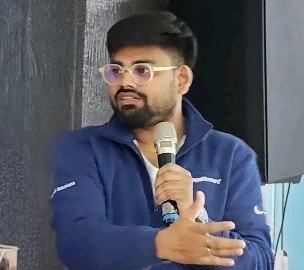
I am Abhijeet Banerjee a dedicated SEO Specialist focused on driving organic growth and improving search visibility. I use a data-driven approach to technical SEO, content strategy, and link building to deliver measurable results and increase ROI for clients and projects