
Ever wonder why some articles pop up in those fancy Google boxes while yours sit on page 3?
Here’s the truth: Google doesn’t just read your content—it scans it like a speed reader looking for specific patterns. And in 2024, the game has changed. It’s not about stuffing keywords anymore. It’s about structure—the way you organize headings, break down paragraphs, and present information that makes Google think, “Yes, THIS deserves the featured snippet.”
Let me break down exactly how to build content that Google can’t ignore.
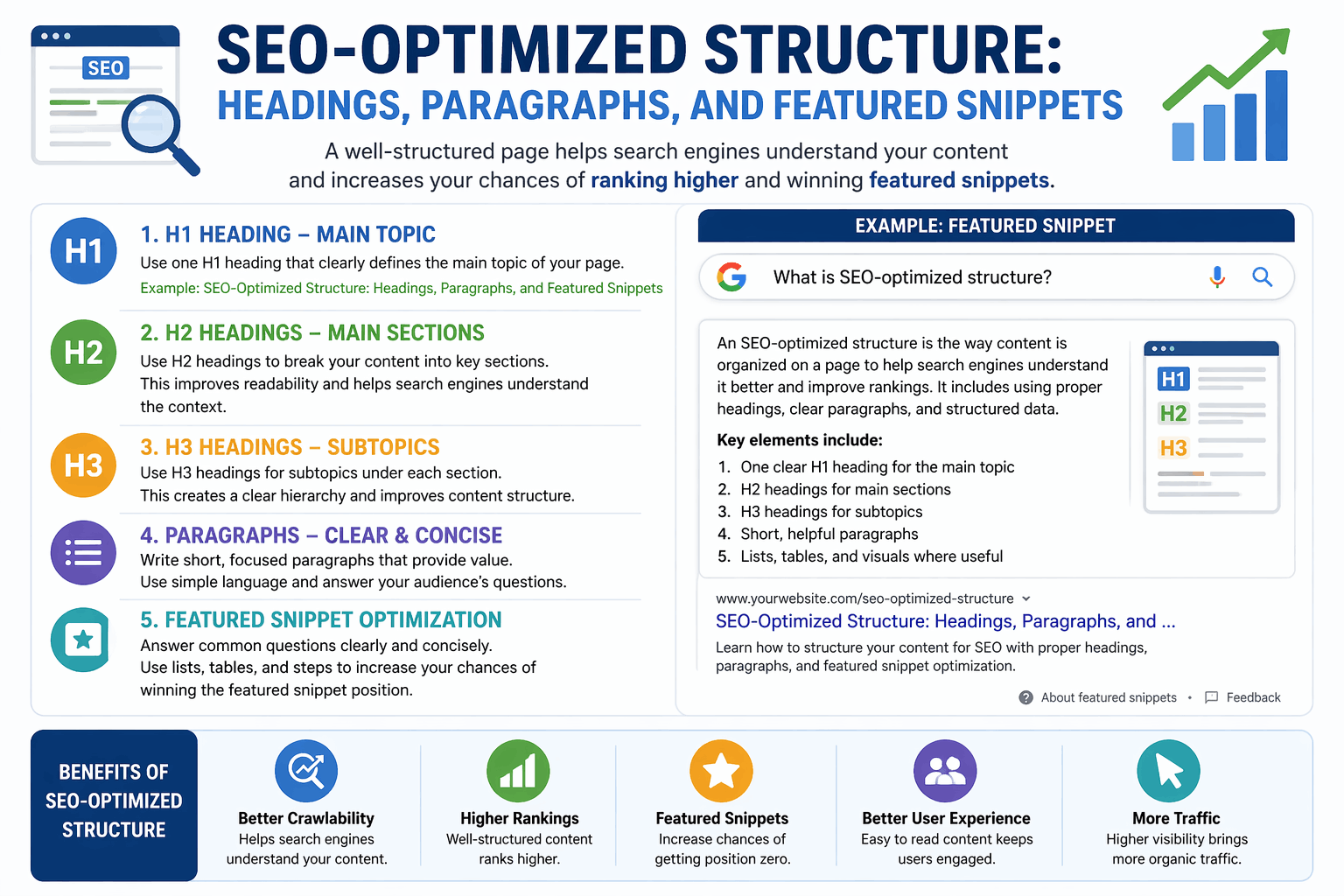
What Exactly Is SEO-Optimized Structure? (The Simple Truth)
Think of your content like a house. You wouldn’t build a house without a blueprint, right?
SEO-optimized structure is your content’s blueprint. It’s how you arrange:
- Headings (your rooms)
- Paragraphs (your furniture)
- Featured snippet opportunities (your front door that invites Google in)
When done right, Google’s crawlers can zip through your page in milliseconds and understand: “This answers the question better than anything else.”
Here’s what most people miss: Google’s algorithm in 2025 uses something called “passage ranking.” This means even a single well-structured paragraph can rank independently. Your entire article doesn’t need to be perfect—just strategically organized.
Claude responded: The Heading Hierarchy That Google Actually Reads (H1, H2, H3 Explained)
The Heading Hierarchy That Google Actually Reads (H1, H2, H3 Explained)
Let’s get real for a second. Most people slap headings randomly on their content like they’re decorating a Christmas tree. That’s not how Google sees it.
Google reads headings like a table of contents in a book. Here’s the breakdown:
H1: Your One and Only Main Title
You get ONE H1 per page. That’s it. This is your headline—the promise you’re making to readers.
Bad H1: “SEO Tips”
Good H1: “7 SEO Structure Mistakes That Are Killing Your Rankings (Fix Them Today)”
See the difference? The second one creates curiosity and promises a solution.
H2: Your Chapter Breaks
These are your main topics. Each H2 should answer a specific question someone might search for.
For example:
- “How Do Headings Affect SEO?”
- “What Makes a Good Paragraph Length for Google?”
- “How to Win Featured Snippets in 2025”
Pro tip: Use question-based H2s. Google LOVES pulling these for featured snippets.
H3: Your Sub-Points
These break down your H2s into bite-sized pieces. Think of them as bullet points with more personality.
Here’s the magic formula:
H1 (Main topic)
└── H2 (Major question/section)
├── H3 (Specific point 1)
├── H3 (Specific point 2)
└── H3 (Specific point 3)
Real talk: Most websites skip H3s entirely or use them wrong. If you master this hierarchy, you’re already ahead of 70% of content out there.
Why Short Paragraphs Win (And Long Ones Kill Your Rankings)
Remember reading textbooks in school? Those massive walls of text that made your eyes glaze over?
Google hates those too.
Here’s the science: The average person’s attention span online is 8 seconds (yep, shorter than a goldfish). Google knows this. That’s why its algorithm now favors content with:
- Paragraphs of 2-4 sentences max
- Plenty of white space
- Easy-to-scan formatting
The Perfect Paragraph Structure
Let me show you two examples:
BAD (What most people write): “SEO optimization is really important for your website because it helps you rank higher in search engines and get more traffic and if you don’t optimize your content properly then you won’t show up in search results and people won’t find your business and you’ll lose customers to competitors who are doing SEO better than you and investing in proper content structure.”
GOOD (What Google wants): “SEO optimization decides whether your website shows up on page 1 or page 10.
Here’s the thing: 75% of people never scroll past the first page of Google. If you’re not there, you’re invisible.
Short paragraphs keep readers engaged. Engaged readers stay longer. Longer time-on-page signals quality to Google. It’s a beautiful cycle.”
See how the second one breathes? That’s what keeps people reading.
Bonus insight: According to recent studies from 2024, pages with paragraph lengths averaging 50-70 words have 18% higher engagement rates than dense text blocks.
Featured Snippets: The Golden Ticket to Position Zero
Okay, this is where things get exciting.
Featured snippets are those boxes that appear above the #1 search result. Google pulls them from content that answers questions clearly and concisely.
Landing a featured snippet can boost your click-through rate by 114%. That’s not a typo.
The 4 Types of Featured Snippets (And How to Win Each One)
1. Paragraph Snippets (The Most Common)
These answer “what is,” “who is,” or “why” questions in 40-60 words.
How to win it:
- Identify a question in your niche
- Answer it in 2-3 sentences directly below an H2
- Use simple, clear language
- Start with the answer, then elaborate
Example: What is SEO-optimized structure? “SEO-optimized structure is the organized layout of headings, paragraphs, and content elements that helps search engines understand and rank your page. It includes proper heading hierarchy (H1-H6), short paragraphs, and strategic formatting that improves both readability and search visibility.”
2. List Snippets (Steps or Rankings)
Google loves numbered lists and bullet points.
How to win it:
- Use H2 or H3 with “steps,” “ways,” “tips,” or “best”
- Create ordered or unordered lists
- Keep each point under 15 words
Example format: “5 Ways to Optimize Your Headings:
- Use only one H1 per page
- Include target keywords in H2s naturally
- Make headings descriptive, not clever
- Follow logical hierarchy (don’t skip levels)
- Add question-based H2s for snippet opportunities”
3. Table Snippets (Comparisons)
These show up for “vs,” “comparison,” or “best” searches.
How to win it:
- Create simple HTML tables
- Use clear column headers
- Compare 2-4 options max
- Keep cell content brief
4. Video Snippets
YouTube descriptions with timestamps can trigger these.
Quick tip: If you’re creating video content, add detailed timestamps in your description. Google pulls these for video snippets.
The Secret Sauce: Schema Markup (Don’t Panic, It’s Simple)
Here’s something an experienced seo freelancer in bangalore taught me: Most people ignore schema markup because it sounds technical. Big mistake.
Schema markup is code that tells Google exactly what your content is about. It’s like adding labels to everything in your house so a blind person (Google’s bot) knows what’s what.
The Most Important Schema Types for Content:
Article Schema – Tells Google: “This is a blog post”
FAQ Schema – Highlights Q&A sections
How-To Schema – Perfect for tutorial content
Breadcrumb Schema – Shows your site structure
The easiest way to add schema? Use plugins like Rank Math or Yoast SEO (for WordPress) or schema generators online. You literally just fill in blanks.
Real impact: Pages with schema markup get 30% more clicks on average. Why? They show up with rich results—star ratings, images, prices, etc.
How Google Decides What Content to Prioritize (2025 Update)
Let’s pull back the curtain on how Google actually thinks.
Google’s algorithm now uses E-E-A-T: Experience, Expertise, Authoritativeness, and Trustworthiness. But in 2025, there’s a new player: Helpfulness.
What “Helpful Content” Actually Means
Google’s Helpful Content Update (rolled out fully in 2024) rewards pages that:
✅ Answer the query completely – No fluff, no beating around the bush
✅ Show real experience – Personal examples, case studies, data
✅ Satisfy the searcher – They don’t need to click back to search again
✅ Load fast on mobile – Under 2.5 seconds
✅ Keep people engaged – Low bounce rate, high time-on-page
Here’s the kicker: Google can now detect AI-generated fluff content. If your article sounds like every other generic blog post, it gets buried.
The “Satisfactory Click” Test
Google tracks what happens after someone clicks your result:
- Good sign: They stay 3+ minutes, scroll 75%, don’t go back to search
- Bad sign: They bounce in 10 seconds and try another result
Your structure directly impacts this. Clear headings help people find answers fast. That keeps them on your page.
The Content Gaps Nobody’s Talking About (Your Competitive Edge)
Want to know the real secret? Find what your competitors AREN’T covering.
Here’s a strategy most people miss:
The “People Also Ask” Gold Mine
When you search any topic, scroll to the “People Also Ask” box. These are real questions people are asking that don’t have great answers yet.
Example: For “SEO structure,” you might see:
- “How many H2 headings should a blog post have?”
- “Can you use multiple H1 tags in HTML5?”
- “What’s the ideal content length for SEO in 2025?”
Answer these in dedicated H2 sections. Boom—instant featured snippet opportunities.
The “Entity Gap” Strategy
Google thinks in entities (people, places, things, concepts). Use tools like AlsoAsked.com to find related entities your competitors haven’t covered.
For example: If everyone writes about “SEO structure,” but nobody connects it to “Core Web Vitals” or “mobile-first indexing,” that’s your gap.
Practical Implementation: Build Your Content Like This
Alright, let’s get hands-on. Here’s your exact blueprint:
Before You Write:
Step 1: Research your main keyword
Step 2: Check the top 10 results
Step 3: List the headings they use
Step 4: Find questions they DON’T answer
Step 5: Create your outline with H2s and H3s
While You Write:
For each section:
- Start with a hook (question, surprising fact, or bold statement)
- Answer the heading directly in the first paragraph
- Add supporting details in short paragraphs
- Use examples, data, or stories
- End with a transition to the next section
After You Write:
✅ Check heading hierarchy (H1 → H2 → H3, no skips)
✅ Scan for paragraph length (break up anything over 4 sentences)
✅ Add schema markup
✅ Include at least one list or table
✅ Verify mobile readability
✅ Add internal links to related content
Common Mistakes That Tank Your Structure (Avoid These)
Mistake #1: Keyword Stuffing in Headings
Google’s smarter than that. Use synonyms and natural language.
Bad: “SEO Structure | SEO Content Structure | Best SEO Structure Tips”
Good: “How to Structure Content That Ranks (Simple SEO Guide)”
Mistake #2: Treating H1 Like an H2
Your H1 should be your page title—unique, compelling, keyword-rich. Don’t waste it.
Mistake #3: Writing for Google, Not Humans
This is the biggest trap. Google rewards content that people actually want to read. If your writing sounds robotic, you’ve lost.
Mistake #4: Ignoring Mobile Format
64% of searches happen on mobile. If your paragraphs look huge on a phone screen, people will bounce.
Mistake #5: No Clear Answer Path
If someone searching “how to optimize headings” has to read 8 paragraphs before getting an answer, they’ll leave.
Measuring Success: What Metrics Actually Matter
You’ve published your perfectly structured content. Now what?
Track These (Not Vanity Metrics):
Engagement Rate – Time on page + scroll depth
Featured Snippet Wins – Use tools like SEMrush or Ahrefs
Click-Through Rate (CTR) – Are people clicking your result in search?
Bounce Rate – Under 60% is good; under 40% is excellent
Internal Link Clicks – Are people exploring more of your site?
Reality check: Rankings might take 3-6 months. But engagement improves immediately with better structure.
Your Next Steps (Make This Work Today)
Don’t let this be another article you read and forget.
Action plan for the next hour:
- Pick one underperforming article on your site
- Rewrite the headings using the hierarchy we discussed
- Break up long paragraphs into 2-4 sentence chunks
- Add one list or table for a potential featured snippet
- Implement basic schema markup
Action plan for this week:
- Analyze your top 3 competitors’ heading structures
- Find 5 “People Also Ask” questions to answer
- Create a content template based on this structure
- Apply it to your next 3 articles
Remember this: Perfect content doesn’t exist. But perfectly structured content that serves your reader? That’s what wins in 2025.
Final Thoughts: Structure Is Your Unfair Advantage
Here’s what nobody tells you: Most of your competition won’t do this.
They’ll keep writing walls of text with random headings. They’ll ignore featured snippets. They’ll skip schema markup because it seems technical.
That’s your opportunity.
Master SEO structure, and you’re not just optimizing for Google—you’re creating content people actually enjoy reading. And when Google sees people engaging with your content, staying on your page, and not bouncing back to search?
That’s when you win the ranking game.
Start small. Pick one article. Apply these principles. Watch what happens.
The playing field just leveled—now go build something Google can’t ignore.
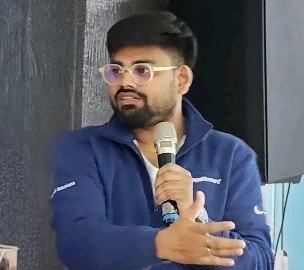
I am Abhijeet Banerjee a dedicated SEO Specialist focused on driving organic growth and improving search visibility. I use a data-driven approach to technical SEO, content strategy, and link building to deliver measurable results and increase ROI for clients and projects